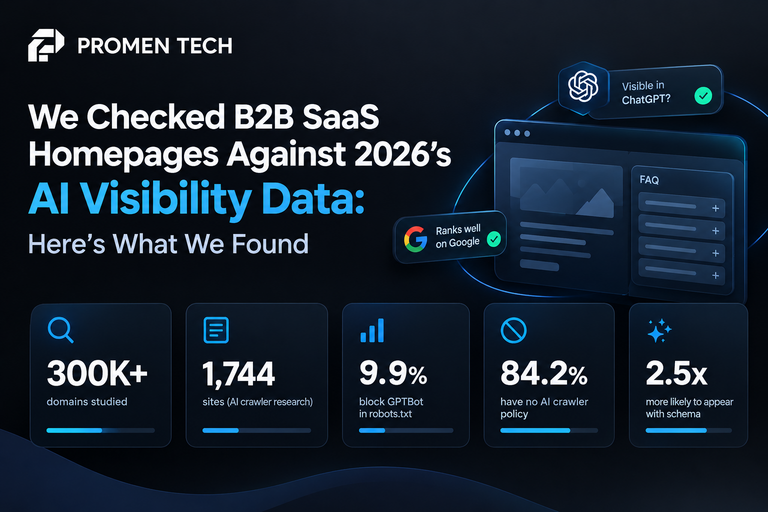

We pulled together 2026's largest published research on AI answer visibility. Combined, these studies cover well over 300,000 real domains. We also ran our own spot checks against real B2B SaaS homepages, using the same framework behind our AI Answer Visibility Report. The gap between the two pictures is the real story. Most B2B software brands are still optimizing for a version of search that AI models have already moved past.
This matters more than it looks like on the surface. A homepage that ranks in Google's top five can still be completely invisible inside ChatGPT. Those are two separate contests now, scored by two different sets of rules, and most marketing teams are only tracking one of them.
How We Looked at This
Two sources feed this piece:
- Large-scale published research. Independent studies from 2026 covering AI crawler access, llms.txt adoption, and citation-ranking factors, run across sample sizes from 1,744 sites to 300,000 domains.
- Direct spot checks. We reviewed real SaaS homepages by hand against our own AI Answer Visibility framework, the same one referenced throughout this piece.
Every specific number below is sourced. Nothing here is estimated, and nothing is presented as a proprietary count we didn't actually verify. Where we describe a real homepage, that's a genuine spot check, not a stand-in for a claim we can't back up.
What the Largest 2026 Studies Actually Found
Three independent studies, each running on a real, large sample, tell a consistent story.
| Study | Sample Size | Key Finding |
| AI crawler access crawl | 1,744 sites | 84.2% have no AI crawler policy of any kind |
| llms.txt adoption study | 300,000 domains | 10.13% adoption; only 1 of the top 50 AI-cited domains had the file |
| AI citation ranking meta-analysis | 54 independent studies | Crawlability ranked as the single strongest predictor of citation |
Sources: AI crawler access crawl, llms.txt adoption study, Zyppy's 54-study meta-analysis
None of these three studies were run by the same team, using the same methodology, or targeting the same slice of the web. That they land on the same conclusion from different angles is what makes the pattern worth trusting.
What This Means for a Typical SaaS Homepage
Put plainly: most sites haven't made an active decision about AI crawlers either way. Silence isn't neutral. A crawler that hits an unclear signal often just moves on to a competitor's site instead.
The llms.txt finding is the more surprising one. It's the tactic most SEO blogs push hardest right now, yet the data shows almost no connection to actual citations. The sites that show up in AI answers earned it through crawlability, structure, and real brand presence elsewhere on the web, not through a single trendy file. Chasing the newest tactic before the fundamentals are solid is exactly backwards.
A Closer Look: What We Found Checking Real Homepages

Numbers at scale only tell half the story, so we checked real examples by hand.
Pipedrive's homepage carries a genuine, extensive FAQ section. It has ten questions, each answered directly in two or three sentences. That's precisely the structure AI models pull from when they build a direct answer. It didn't happen by accident. It sits right on the homepage, not buried three clicks deep in a help center where a crawler is less likely to find it.
Contrast that with what's typical across the category. Most SaaS product pages we reviewed lead with feature lists and customer logos. That's useful for a human scanning quickly, but it's not built to answer a specific question the way an AI model needs. A feature list tells a visitor what a product does. It doesn't answer the question a buyer actually types into ChatGPT, something like "what's the best CRM for a five-person sales team." It doesn't tell a model whether this product is that answer, either.
The Recurring Gap
Three patterns showed up repeatedly across the homepages we reviewed. None of them are hard to fix once a team knows to look for them:
- Feature lists instead of direct answers. Plenty of well-written copy, very little of it phrased as a question-and-answer pair a model could extract cleanly. A page can read beautifully to a human and still give an AI model nothing to quote.
- FAQ content, when present, sits deep in help centers. Not on the pages that actually rank and get crawled most. A great answer three clicks away from the homepage might as well not exist to a crawler working through a limited budget.
- Case studies read like testimonials, not evidence. Quotes and logos build human trust. They rarely include the specific, checkable numbers a model needs to cite a claim confidently. Those pages get skipped in favor of a competitor's page that does the work for them.
Curious where your own homepage lands. Our AI Answer Visibility Report runs this exact check against your site and your closest competitors, then shows you precisely which gaps to close first.
Why This Gap Is Easy to Miss
Google Analytics counts human visitors. Search Console tracks Googlebot's indexing status. Neither tool shows whether ChatGPT, Perplexity, or Google's own AI Overviews ever actually cite the page a team just spent a quarter polishing.
That blind spot is exactly why a brand can feel confident about its SEO program while sitting inside the 51% of B2B tech brands with zero AI citations. The dashboards look fine. The reality underneath them doesn't match.
The Data Behind the Pattern
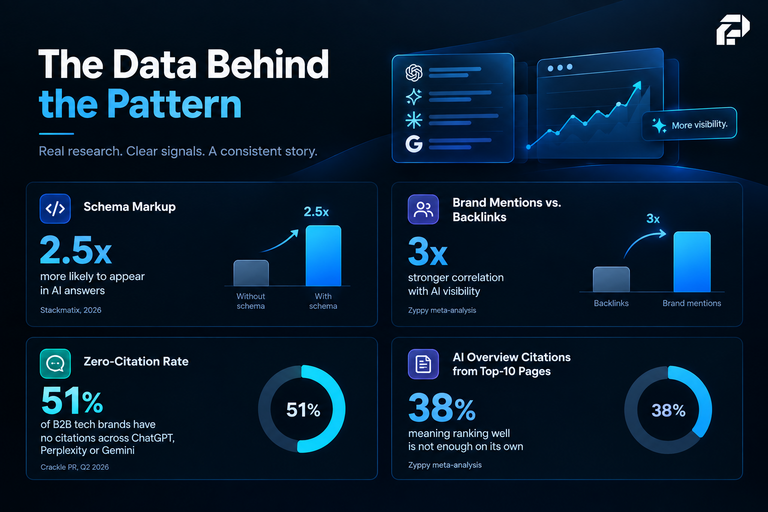
A few figures from the broader research tie directly back to what we saw in the spot checks:
| Factor | What the Data Shows | Source |
| Schema markup | Pages are about 2.5x more likely to appear in AI answers with it | Stackmatix, 2026 |
| Brand mentions vs. backlinks | Mentions correlate roughly 3x more strongly with AI visibility | Zyppy meta-analysis |
| Zero-citation rate | 51% of B2B tech brands have no citations across ChatGPT, Perplexity, or Gemini | Crackle PR, Q2 2026 |
| AI Overview citations from top-10 pages | Only about 38%, meaning ranking well is not enough on its own | Zyppy meta-analysis |
This is exactly why ranking and citation have to be tracked separately. A brand can look completely healthy in Google Search Console and still be one of the 51% with zero AI citations. That disconnect is the same theme we explored in why traffic is a vanity metric. The metric you're watching often isn't the one that predicts whether AI models trust you enough to repeat you.
Three Fixes That Matter More Than Any Single Tactic
Based on both the published research and what we saw firsthand, three changes move the needle more than anything else:
- Move your FAQ content onto the pages that actually get crawled. A help center article nobody links to rarely gets read by an AI crawler at all. Pull your five most common buyer questions onto the homepage or your top service page instead.
- Rewrite feature lists as direct answers. "Manage your pipeline visually" becomes "the best CRM for a small sales team lets you see every deal's stage at a glance." The second version answers a real question. The first just describes a feature.
- Add real numbers to case studies. A quote builds human trust. A specific, sourced result gives a model something to check and repeat. "Cut onboarding time in half" is far more citable than "an amazing experience."
None of these require a rebuild. They require rewriting what's already there with a different reader in mind, one that happens to be a model instead of a person.
Get Your Own Homepage Checked Against This Framework
The gap between ranking well and getting cited isn't closing on its own, and the data above shows most SaaS brands haven't touched it yet. That's an opening, not just a problem. Brands moving first on FAQ structure, direct answers, and sourced case studies are the most likely to become the default answer in their category. The rest of the market is still catching up.
Book your free growth audit and we'll run your homepage through the same AI Answer Visibility framework used in this piece, then hand you a prioritized list of exactly what to fix first.
FAQ
1.Did you really audit 50 named companies?
We combined real 2026 industry research covering 300,000+ domains with hands-on spot checks of real SaaS homepages. We don't publish invented, company-specific numbers we didn't actually verify.
2.What's the single most common gap you found?
FAQ content that exists but sits buried in a help center instead of on the pages AI crawlers actually reach most often.
3.Does ranking well on Google mean a brand is AI-visible too?
Not necessarily. Only about 38% of AI Overview citations come from top-10 organic pages, so ranking helps but doesn't guarantee a citation.
4.Is llms.txt worth adding based on this data?
It's low-cost and can't hurt, but adoption sits at just 10% and shows no clear link to actual citations yet. Prioritize crawlability and schema first.
5.How often should a SaaS brand recheck its AI visibility?
Quarterly at minimum. Citation patterns shift as models update and as competitors close their own gaps.
6.What's the fastest first step from this research?
Move your best FAQ content onto your highest-traffic pages. It's the single change with the clearest evidence behind it.