
Enough public pricing data now exists to skip that whole dance. This guide breaks down what real AEO and GEO work costs in 2026. It covers what actually drives the price up or down. It shows how those numbers stack up against a published, transparent alternative. By the end, you'll be able to look at any quote and know within a few minutes whether it's fair.
Why So Many Agencies Still Hide Their Pricing
Hidden pricing made more sense back in 2024. Almost nobody knew what this work cost to deliver or how to scope it back then. That excuse doesn't hold up anymore. Enough agencies now publish real numbers that a rough market range costs nothing to share.
The real reason pricing stays hidden is simpler. A published number invites comparison, and a lot of AEO offers don't hold up well next to one. Once a buyer can see three real quotes side by side, vague deliverables start looking thin fast. Terms like "content optimization" and "authority building" stop sounding impressive once there's something real to compare them to.
If a quote sits far outside the ranges below, that's worth asking about directly, not accepting quietly. A number alone tells you almost nothing. What it's attached to tells you everything.
What Actually Drives the Price
Three factors explain almost all of the spread between a $1,000 quote and a $20,000 one:
- Scope of off-site work. AEO covers on-site fixes like schema and direct-answer formatting, work that's contained to your own website. GEO adds off-site brand-mention building across reviews, press, and community platforms. That work happens on sites you don't control, which takes more hands-on effort and costs more per hour.
- Number of pages and platforms tracked. Auditing five pages against one AI platform costs far less than auditing two hundred pages against seven. Most quotes scale close to linearly with page count, but platform count adds cost in a different way, since each platform needs its own testing method.
- Reporting depth. A basic monthly summary is cheap to produce, often just an export from a dashboard. Weekly citation testing across ChatGPT, Perplexity, Gemini, and AI Overviews takes real analyst time. That time shows up directly in the price.
A fourth factor matters too, even though it's harder to quantify: how mature your current content already is. A site starting from zero schema and zero off-site presence costs more to bring up to standard than a site that already has half the groundwork done.
The Real 2026 Price Ranges

Here's what the market actually charges, pulled from multiple independent 2026 pricing guides rather than one agency's opinion of itself.
| Tier | Typical Monthly Cost | What You Get |
| Self-serve tools | $29 – $489 | Citation tracking software only; you do the implementation work yourself |
| Starter agency retainer | $2,000 – $3,500 | Basic schema, FAQ structure, and light off-site monitoring |
| Mid-market / growth retainer | $3,000 – $10,000 | Full technical AEO plus active GEO: reviews, press, brand mentions |
| Enterprise retainer | $15,000 – $25,000+ | Large-scale schema deployment, weekly citation audits, dedicated reporting |
| One-time audit | $1,000 – $5,000 | A single scoped review with recommendations, no ongoing work |
Sources: AEO/GEO agency cost guide, AEO and GEO pricing 2026
The Floor Matters More Than the Ceiling
One detail shows up across nearly every published guide: anything under roughly $1,500 a month is almost always rebranded SEO with an AEO label stapled on. That floor is where buyers get burned, not at the high end. A low quote usually means thin scope, not a bargain.
Two Quotes, Same Price Tag
Picture two agencies quoting the same $4,000 a month.
Agency A's proposal lists "content optimization," "authority building," and "AI visibility monitoring." That's it. No page counts. No platform list. No sample report.
Agency B's proposal is different. It specifies six new pages a month. It names four AI platforms it actively monitors. It includes a sample citation report from a real client, showing exactly which queries their brand now appears in.
Same number on the invoice. Only one of these tells you what you're actually buying. The specificity is the real price signal, not the dollar figure by itself.
This gap shows up constantly in real proposals. Vague line items aren't necessarily dishonest, they're often just easier to write than a real scope. But easier to write usually means easier to underdeliver against later, since there's nothing specific to hold the agency to.
See exactly what's included at every price point. Our full pricing and packaging breaks down what's in each tier, with nothing held back until a sales call.
How Promentech's Pricing Compares
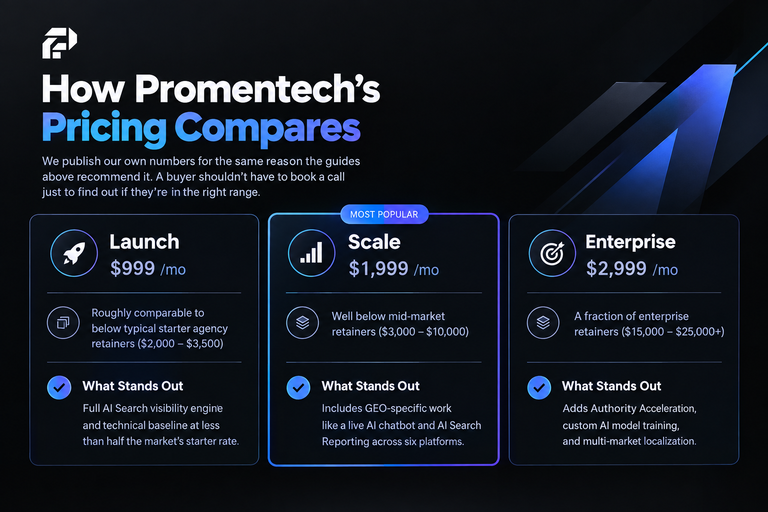
We publish our own numbers for the same reason the guides above recommend it. A buyer shouldn't have to book a call just to find out if they're in the right range.
| Promentech Tier | Monthly Price | Roughly Comparable Market Tier | What Stands Out |
| Launch ($999/mo) | $999 | Below typical starter agency retainers ($2,000–$3,500) | Full AI Search visibility engine and technical baseline at less than half the market's starter rate |
| Scale ($1,999/mo) | $1,999 | Well below mid-market retainers ($3,000–$10,000) | Includes GEO-specific work like a live AI chatbot and AI Search Reporting across six platforms |
| Enterprise ($2,999/mo) | $2,999 | A fraction of enterprise retainers ($15,000–$25,000+) | Adds Authority Acceleration, custom AI model training, and multi-market localization |
The gap isn't a mistake. Most agencies price for a mix of AEO theory and GEO promises. That pricing is still bundled with legacy SEO retainer habits from before AI search even existed. Those older habits carry real overhead. Think account managers, separate reporting tools, and manual research. A model-driven process handles most of that automatically. Cutting that overhead is part of why the published range above sits where it does, not a sign that less work is happening behind the scenes.
That said, price alone still isn't the full picture. A lower number only matters if the deliverables underneath it hold up. Here's how to check that.
What You Should Actually Get for the Price
A number alone doesn't tell you if a quote is fair. The same dollar figure can hide a great deal or a bad one, depending on what's attached to it. Ask for these three things before signing anything:
- Deliverable counts, not just deliverable categories. "Content optimization" means nothing on its own. Ask for a number, like pages per month or citations earned per quarter.
- Citation evidence, not just activity reports. An agency charging enterprise rates should show you which AI platforms are actually citing your pages, for which queries, not just a list of tasks completed.
- A reporting cadence that matches the price. A basic retainer with weekly reporting promises is a mismatch. Either the agency is underdelivering elsewhere, or the retainer is priced too low to sustain it.
This same "widen the definition of optimization" idea runs through our post on AEO vs GEO vs SEO. It explains why these two disciplines cost more to execute well than traditional SEO ever did.
Get a Real Number for Your Own Site
Pricing pages full of vague tiers and "contact us for enterprise" buttons make it hard to know if you're being quoted fairly. The ranges above exist so you don't have to guess, and so you can walk into any sales call already knowing what a fair range looks like for your situation.
Book your free growth audit, and we'll show you exactly what a plan for your site would include, and exactly what it costs, before you ever have to ask.
FAQ
1. Is $999 a month realistic for real AEO and GEO work?
Yes, when the scope is tightly defined. Our Launch tier covers technical baseline and AI search visibility work; broader GEO campaigns cost more at any agency.
2. Why do some quotes go as high as $25,000 a month?
That range covers large enterprises auditing hundreds of pages across seven AI platforms with weekly reporting. Most SaaS companies don't need that scope yet.
3. Should I buy a one-time audit or a monthly retainer?
An audit works if your team can implement the fixes internally. A retainer makes sense if you want ongoing citation monitoring and ongoing content work.
4. What's a red flag in an AEO or GEO quote?
Anything under roughly $1,500 a month with no specific deliverable counts. That price point rarely covers more than relabeled SEO work.
5. Do self-serve AI visibility tools replace agency work?
No. Tools like citation trackers show you the data. They don't fix schema, write content, or build the off-site mentions that actually move the numbers.
6. How often do these price ranges change?
Expect them to keep shifting as the market matures. Check published guides quarterly, since this space moved fast throughout 2025 and 2026.