Ask five people on your marketing team to define GEO. You’ll likely get five different answers. Ask them to draw a line between GEO and AEO, and most will just shrug. That’s not a gap in your team’s knowledge. It’s the real state of the industry.
A Search Engine Land review of LinkedIn posts found something telling. Fewer than a third of SEO influencers used the terms AEO and GEO the same way all year.
That confusion has a cost. Software brands pour budget into “AI search optimization” without agreeing on what it means or how to measure it. This guide untangles SEO, AEO, and GEO in plain terms. Then it shows what changes in practice, backed by fresh 2026 data.
Why This Isn’t Just a Semantics Argument
Getting these terms right isn’t academic housekeeping. It decides where your next quarter of budget goes. A 2026 Goodfirms survey polled over 100 marketers. 65% named adapting to AI-driven search as their single biggest challenge, ahead of algorithm changes and shrinking budgets. Teams that can’t tell SEO, AEO, and GEO apart end up running one blurry program instead of three sharp ones.
The stakes already show up in how work gets priced. Some agencies now charge for AEO and GEO work separately from regular SEO. The deliverables and skills differ that much. If your team treats “AI search optimization” as one line item, you’re probably underfunding something. Usually it’s whichever piece gets the least attention.
What Each Term Actually Means
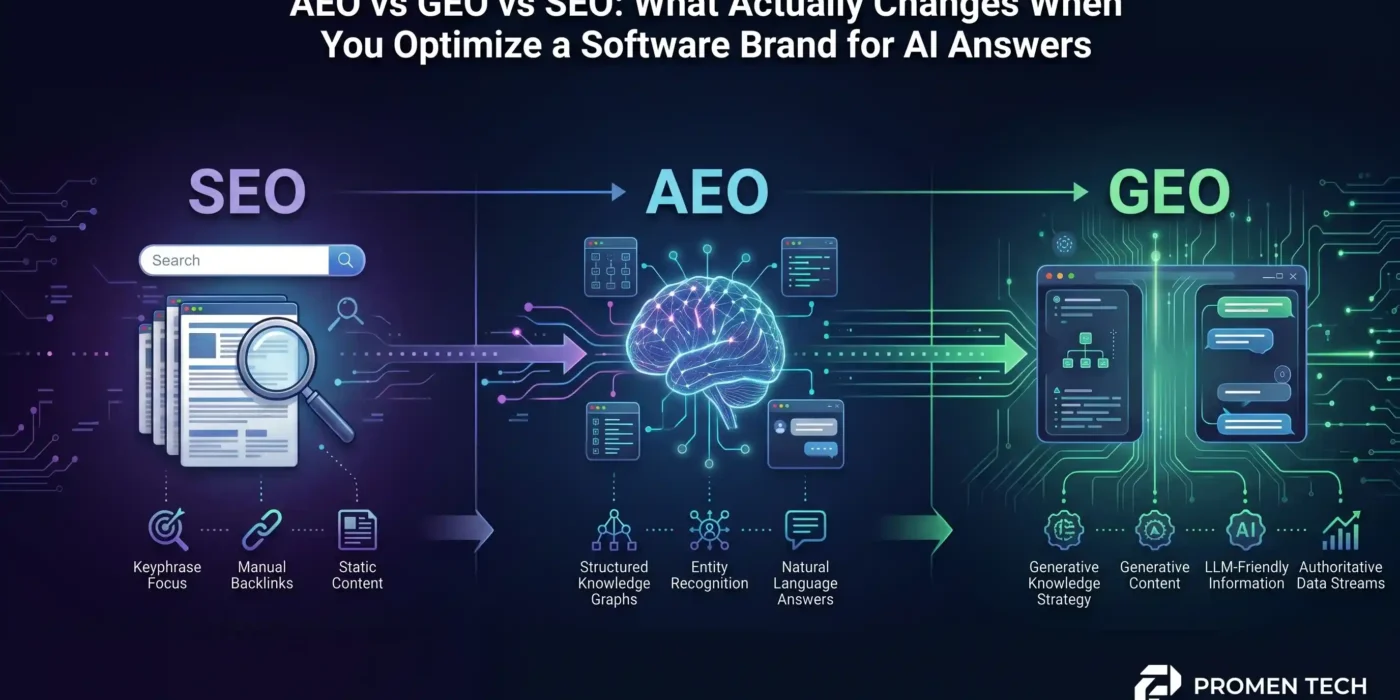
Here’s the clearest way to split the three apart. Each one optimizes for a different moment in how someone finds information.
| Discipline | Primary Goal | What It Optimizes For | Primary Metric |
| SEO | Rank in the list of search results | Keywords, technical health, backlinks | Organic rank and clicks |
| AEO | Become the direct answer inside a snippet or answer box | Query-answer match, structured content, concise phrasing | Featured snippet and “People Also Ask” appearances |
| GEO | Get cited or mentioned inside an AI-generated response | Brand mentions, entity authority, content freshness | Citation frequency and share of voice |
SEO is the oldest of the three. It optimizes for a click on a page in a results list. AEO grew out of voice search and featured snippets. It optimizes for your content getting pulled out as a direct answer, often with no click at all. GEO is the newest layer. It optimizes for your brand getting named inside a generated answer. That answer might come from ChatGPT, Perplexity, or Google’s AI Overviews. It counts whether or not the answer links back to you.
None of the three replaces the others. They stack instead. Strong technical SEO makes a page more likely to rank. A well-structured page is more likely to get pulled into a snippet. A brand with real off-site presence is more likely to get named by an AI model.
Where the Confusion Actually Comes From
Part of the mess is simple. The industry hasn’t settled on shared definitions yet. Agencies, publishers, and consultants use GEO, AEO, GSO, LLMO, and AIO to describe the same work. A Search Engine Land analysis found that 59% of SEO influencers use the term “GEO,” while the rest reach for something else.
There’s a second layer of confusion too. Two common beliefs about GEO sit at opposite extremes, and both miss the mark. Some marketers think good SEO automatically means good GEO results. Others think GEO needs a whole new, unrelated skill set. Neither is quite right. The tactics overlap a lot, but the data doesn’t support treating GEO as just a rebrand of SEO either.
What Actually Changes in Practice for a Software Brand
Definitions help, but they don’t tell you what to do differently on Monday morning. Here’s where the real work shifts once AEO and GEO join your SEO program.
| SEO Practice | What Changes Under AEO/GEO | Why It Matters |
| Chase backlinks for domain authority | Treat unlinked brand mentions as an equal priority | Only 19% of marketers name brand authority a strategic priority, even though most already do the outreach work |
| Track rank position and organic sessions | Add citation frequency and branded search volume as core metrics | Just 14% of marketers track AI or LLM citation visibility, despite 43% calling AI optimization a core 2026 strategy |
| Write comprehensive, dense articles | Lead with a plain, direct answer in the first two sentences | Only 70% of marketers write in plain language, even though it’s close to a requirement for AI citation now |
| Publish once, refresh occasionally | Refresh cornerstone pages on a real, recurring cadence | AI engines weigh recency heavily when they choose which source to cite |
| Optimize one page per keyword | Build topic clusters that stack related sub-questions | Google still handles about 417 billion searches a month. ChatGPT handles about 72 billion messages. Both scales reward topical depth |
Sources: Goodfirms 2026 AI SEO Statistics survey, EMARKETER FAQ on GEO and AEO
The pattern in every row looks the same. AEO and GEO don’t ask you to throw out SEO fundamentals. They ask you to widen what “optimization” even means, beyond a single page and a single keyword.
See where your own content sits today. Our AI answer visibility work maps which of these shifts your site has made, and which gaps still cost you citations across ChatGPT, Perplexity, and AI Overviews.
The Same Page, Optimized Three Different Ways
Picture one page: “How to Choose a Project Management Tool for a Remote Team.” Here’s how each discipline shapes it differently.
Under SEO alone, the page targets one keyword phrase. It links to related pages and earns backlinks from industry roundups. Success looks like ranking in the top five.
Add AEO, and the structure changes. The first two sentences now answer the question directly, in about 40 to 60 words. Subheadings turn into questions a buyer would actually type. Success now also means showing up in a featured snippet or a “People Also Ask” box.
Add GEO on top, and the focus shifts off the page entirely. The team starts earning mentions on Reddit threads, G2 reviews, and comparison roundups elsewhere on the web. The page itself gets refreshed on a set schedule instead of sitting untouched for a year. Success now includes how often the brand’s name turns up inside an AI-generated answer, link or no link.
AEO, GEO, and SEO by the Numbers
A few figures show where things stand right now:
- 43% of marketers are actively running GEO strategies in 2026, up from near zero a year earlier
- 14% of marketers actually track AI or LLM citation visibility today
- 86% is roughly how far ahead of competitors you land just by starting basic AI citation tracking now, since so few do it yet
- 58.5% of Google searches now end without a click to any website
- 31.3% of the US population is projected to use generative AI search at all in 2026
- 59% of SEO influencers use the term “GEO.” Most of the rest use something else for the same work
How to Decide Which One to Prioritize First
You don’t need all three running at full strength on day one. Work through this order instead:
- Check your SEO foundation first. Fix technical issues or thin content before adding anything else. Both AEO and GEO need a solid base underneath.
- Add AEO if buyers ask specific questions. If your category involves comparison shopping or how-to research, structuring content to win snippets pays off fast.
- Invest in GEO once your brand has some market presence. GEO leans on off-site mentions and reviews. A brand-new company with no external presence yet won’t see much lift.
- Revisit the order every quarter. Buyer behavior can shift which discipline earns the best return.
This same “widen the definition” shift shows up in our post on programmatic SEO without the spam. Scaling content only worked once quality and structure scaled right alongside it.
Get an AEO and GEO Plan Built for Where Your Brand Actually Stands
Most software brands don’t need three separate agencies or three separate strategies. They need one team that treats SEO, AEO, and GEO as layers of one system, not competing budget lines.
Book your free growth audit and we’ll show you where your content stands across all three disciplines today, and which one will move the needle first for your category.
FAQ
- What’s the simplest way to explain the difference between SEO, AEO, and GEO?
SEO gets you ranked in a list of links. AEO gets your content pulled out as a direct answer. GEO gets your brand named inside an AI-generated response. - Do I need to pick just one of these to focus on?
No. They work as layers, not alternatives. Most software brands eventually run all three, just not always at the same time or intensity. - Is GEO just a rebrand of SEO?
Not quite. The tactics overlap a lot, but GEO leans much more on off-site brand mentions and entity authority than classic link-building does. - How long does GEO work take to show results?
It varies by platform. Some AI engines pull in fresh content within hours. Brand-authority signals like reviews and mentions build up over months, not days. - Can a small software brand compete in AI search against bigger competitors?
Yes, more easily than in classic SEO. AI engines favor specific, well-sourced answers over generic ones. That rewards depth and structure more than raw domain size. - What’s the fastest first step if I haven’t started any of this?
Ask ChatGPT or Perplexity a question your buyers would realistically type. See if your brand shows up at all. That single check tells you where to start.