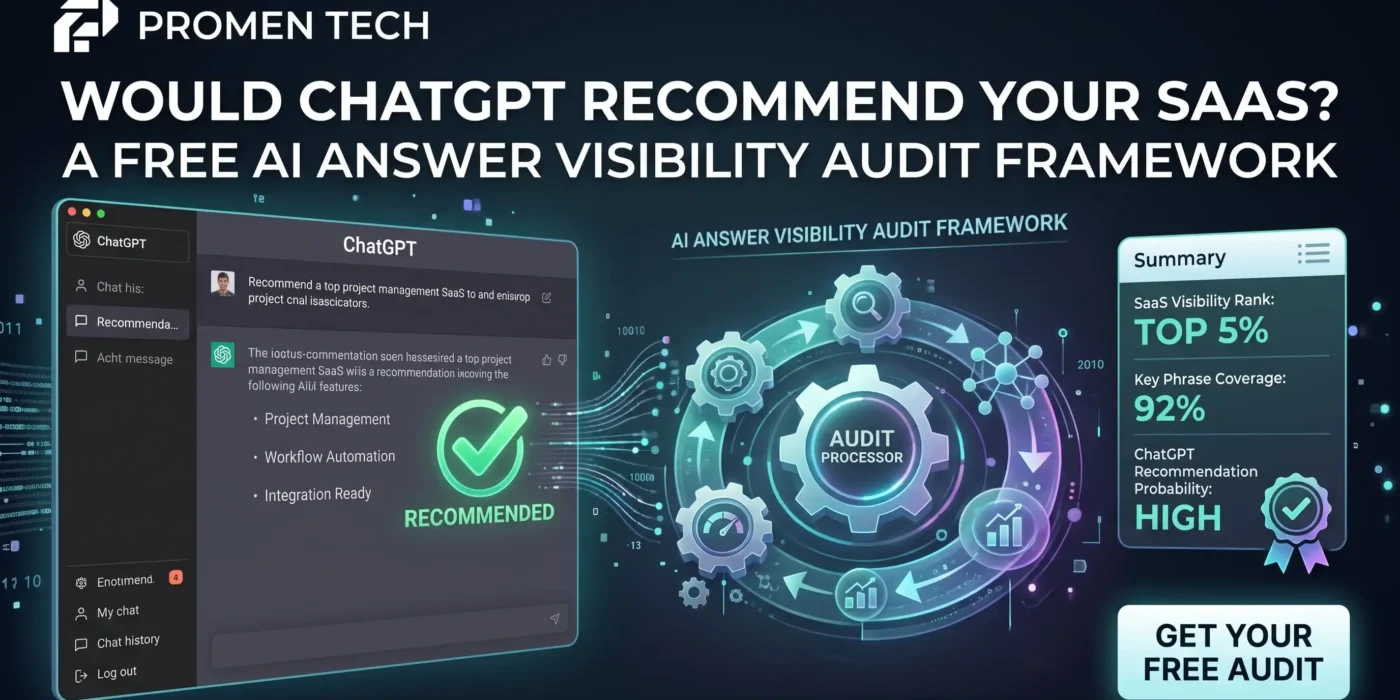
Open a new ChatGPT tab right now. Ask it to recommend a tool in your category. Then check: did your brand show up?
For most B2B software companies, the answer is no. It’s not because the product is weak. It’s not because the marketing team isn’t trying. It’s because almost nobody builds content the way AI models actually read it. And almost nobody runs an AI answer visibility audit to find out where the gaps are.
That silence costs money. Buyers aren’t waiting for your homepage anymore. They ask ChatGPT, Perplexity, and Google’s AI Overviews to build them a shortlist. If your brand isn’t part of that answer, you were never in the running. That’s the exact problem an AI answer visibility audit solves. Below, we’ll walk through the framework we use. We’ll show you what a real audit finds. We’ll back it with the newest research on how these tools pick what to cite. And we’ll give you a self-check you can run before you spend a dollar.
Why This Matters More Than Your Google Rankings Right Now
For years, “rank on page one” was the whole game. That’s not true anymore. A 2026 Forrester report checked in on B2B software buyers. It found that 72% of them now check ChatGPT before they pick a vendor. It also found that 44% use Perplexity to build a shortlist. Bain’s 2026 study found something else. The average buyer runs 17 AI searches a week. That’s not a small habit. That’s now the normal way software gets found, whether your team has a plan for it or not.
Here’s the part that should worry most marketing teams. A 2026 study by Crackle PR checked citations across ChatGPT, Perplexity, and Gemini. It found that 51% of B2B tech brands get zero citations, on any of the three. Buyers are asking the question. Half of all vendors just aren’t part of the answer. Every month that gap stays open, a rival gets to fill it instead.
And when a brand does get mentioned, it changes how buyers feel. This happens before a single sales call. A 2026 G2 survey polled over 1,000 B2B software buyers. 85% said they think more highly of a vendor when an AI chatbot recommends it. 53% now say AI research feels more useful than a normal search. That’s up sharply from just 36% a year earlier. Buyers trust the shortlist an AI hands them. If you’re not on it, you’re fighting to join a list that’s already closed.
This is also why raw traffic numbers can fool you. A page can pull steady visits and still do nothing for your brand in AI search. We covered that same gap in our post on why traffic is a vanity metric.
Where Buyers Are Actually Asking About You
An AI answer visibility audit doesn’t check just one platform. Different AI tools pull from different sources. Each one rewards different signals. A brand can look strong on one platform and stay invisible on another.
| Platform | How It Sources Answers | What It Rewards |
| ChatGPT | Trained data plus live web search for buying-related questions | Clear structure, FAQ tags, answers stated up front, mentions on Wikipedia and in the news |
| Perplexity | Fresh web search on every single question | New content, clear sources, pages indexed recently |
| Google AI Overviews | Google’s normal search index | Top-10 rankings, valid schema tags, short direct answers |
| Gemini | Google’s index plus Google’s knowledge graph | Clear entities, structured data, a consistent brand across the web |
| Claude | Careful web search, leans less on forums | Trusted, well-sourced, expert-reviewed content |
| Copilot | Bing’s search index | Signals close to ChatGPT’s live search layer |
| Grok | Real-time web and social posts | Recent news, social buzz, trending topics |
A brand that only works on ChatGPT is still invisible on the other six platforms buyers use every day. That’s why a real audit tracks all seven, instead of chasing whichever one is in the news that quarter.
What a Real AI Answer Visibility Audit Checks
A useful audit is not one pass-or-fail score. It breaks your site down by the exact things that decide whether AI models cite a page. SEO researcher Cyrus Shepard reviewed 54 studies on this in May 2026. He ranked each factor by strength of evidence. The pattern is clear. Models cite pages they can reach. They cite pages that already rank well. And they cite pages that answer the exact question a person asked.
| Audit Pillar | What It Measures | Why It Predicts Citation |
| Crawlability & access | Can AI tools reach and read the page cleanly | The single strongest factor across 54 studies |
| Search rank overlap | Does the page already rank in Google’s top 10 | About 38% of AI Overview citations come from top-10 pages |
| Structure & schema | FAQ, Article, and Organization tags on the page | Pages with schema are about 2.5x more likely to show up in AI answers |
| Query-answer match | Does the page answer the exact words a buyer would type | A high-strength factor tied straight to which pages get picked |
| Freshness | How recently the page was updated | Cited pages run about 25.7% newer than typical top-10 pages |
| Brand mention density | How often your brand gets mentioned across the web, not just linked to | Brand mentions link to AI visibility about 3x more strongly than backlinks alone |
Sources: Zyppy’s 54-study AI citation meta-analysis, Stackmatix schema markup study
Each pillar gets its own score instead of one blended number. A site can be strong on schema and still stay invisible if almost nobody mentions the brand anywhere else online. Scoring the six pillars apart is what actually tells you where to spend your next sprint.
A Live Audit: What We Found on a Sample SaaS Homepage
We ran this exact framework on a mid-market SaaS homepage. We wanted to see what a real audit turns up. The site ranked well on Google. It sat in positions four through nine for its main terms. On paper, that looked healthy.
The AI visibility picture told a different story. The homepage had no FAQ schema anywhere. Its blog posts answered questions in long, wordy paragraphs. An AI model couldn’t lift a clean answer from them. And its newest case study, its single best asset for earning a citation, was over a year old.
The result: strong Google rankings, almost no presence in ChatGPT. This pattern shows up often. Ranking well and getting cited are related jobs. But they’re not the same job. That mix-up is exactly why so many SaaS brands with solid SEO still hear silence when someone asks ChatGPT for a recommendation.
See what your own site is missing. This is the same walkthrough our AI Answer Visibility Report runs on your homepage, blog, and case studies. We score each pillar above, across all seven platforms.
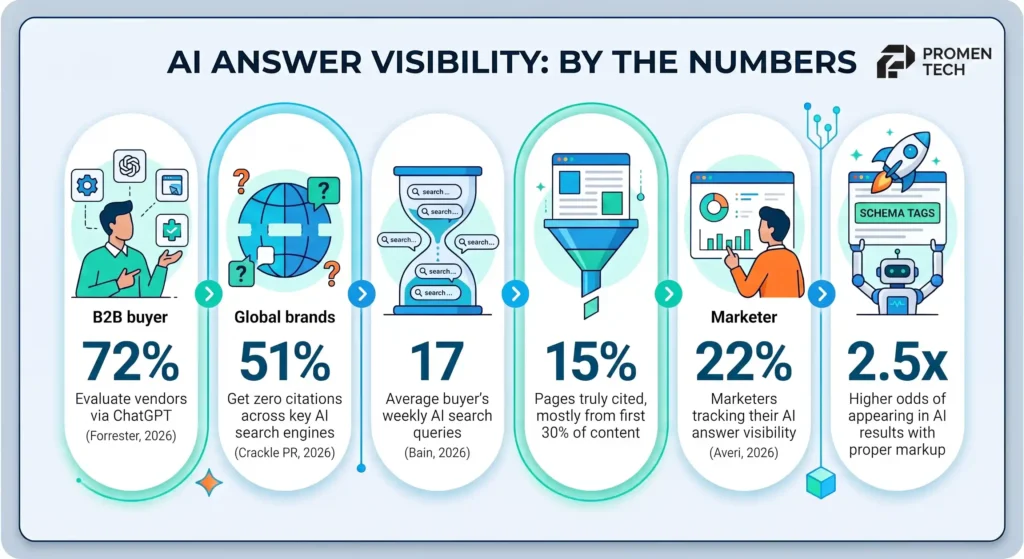
AI Answer Visibility by the Numbers
A few data points show how big this shift really is:
- 72% of B2B software buyers now use ChatGPT while they evaluate vendors (Forrester, 2026)
- 51% of B2B tech brands get zero citations across ChatGPT, Perplexity, and Gemini (Crackle PR, 2026)
- 17 AI search queries run by the average buyer every week (Bain, 2026)
- 15% of the pages ChatGPT pulls up are the ones it actually cites, mostly from the first 30% of a page
- 22% of marketers track their AI visibility at all, despite this shift in buyer habits (Averi, 2026)
- 2.5x higher odds of showing up in AI answers for pages with proper schema tags
Put together, these numbers point to a short window. Brands building AI-friendly content now are grabbing a shortlist spot before most rivals even know the shortlist exists. A year from now, the top citation spots in most SaaS categories will likely be locked in. That’s much like top-three Google spots once they’ve held steady for a while. Early movers win the bigger share.
The 8-Question Self-Check You Can Run Today
Before you pay for a full audit, you can spot the biggest gaps yourself. Ask these questions about your own site:
- Does your homepage or top service pages have FAQ schema?
- Do your blog posts answer the question in the first two sentences, or build up to it slowly?
- When did you last publish an original data point, benchmark, or study?
- Are your case studies less than six months old?
- Does your brand get mentioned on sites you don’t own, not just linked to?
- Can you find your own brand when you search your category on ChatGPT?
- Does your top-ranking Google page also show up when you ask an AI tool the same question?
- Do you track your AI citations at all, month over month?
If you said no more than twice, you likely have real gaps an audit would catch. Each “no” points to one of the six pillars above, and a rival is probably already ahead of you there.
Get Your Free AI Answer Visibility Audit Before a Competitor Claims Your Spot
AI answer engines don’t wait for brands to catch up. The longer you wait, the more locked in that shortlist gets. Every month without a citation plan is a month a rival gets to become the go-to answer in your category, instead of you.
Book your free growth audit and find out exactly what ChatGPT, Perplexity, and Google AI Overviews say about your brand today. You’ll walk away with a clear plan to close every gap.
FAQ
- What is an AI answer visibility audit?
It’s a check of how often AI tools like ChatGPT and Google AI Overviews mention your brand. It scores your site on access, schema, freshness, and brand mentions.
- How is this different from regular SEO?
SEO aims to rank in a list of links. AI visibility aims to be the fact a model actually states out loud. A page can rank well and still never get cited.
- Which AI platforms should a SaaS brand actually track?
Start with ChatGPT, Google AI Overviews, and Perplexity, since they cover most buyer research. Keep an eye on Gemini, Claude, Copilot, and Grok too.
- How long does it take to start showing up in AI answers?
It depends on the platform. Perplexity can pick up new content within hours. ChatGPT and Google AI Overviews move on slower cycles.
- Does schema markup really make a measurable difference?
Yes. Pages with proper schema tags are about 2.5 times more likely to show up in AI-written answers than pages without them.
- What’s the fastest way to know if I have a problem?
Run the 8-question self-check above. Then ask ChatGPT a question a real buyer would ask. If your brand doesn’t show up, that’s your answer.