Two software companies publish the same statistics in almost the same words. ChatGPT cites one of them by name. It ignores the other completely. The data isn’t the difference. The difference is trust, and E-E-A-T measures exactly that.
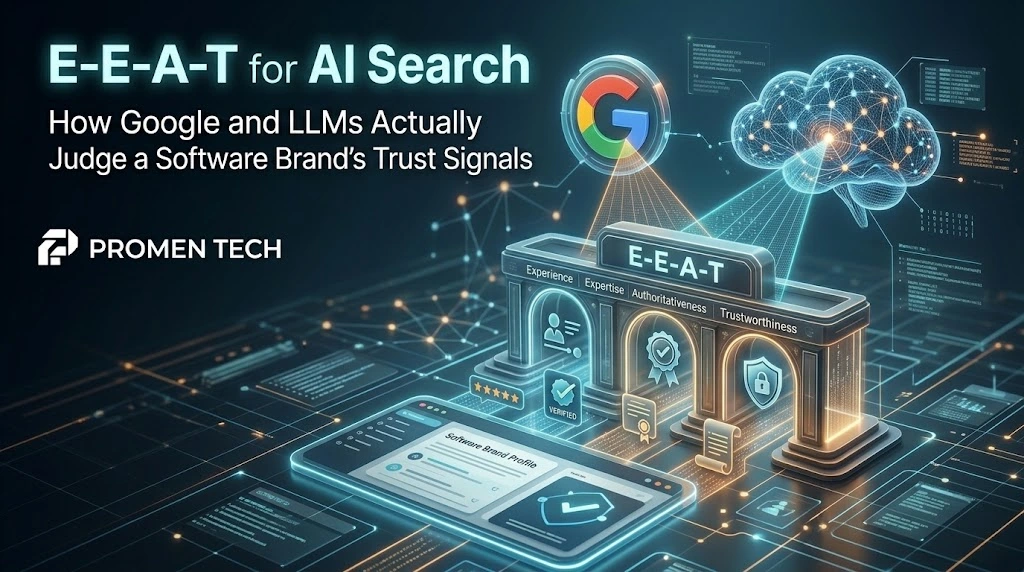
E-E-A-T stands for Experience, Expertise, Authoritativeness, and Trust. Google built it as a quality framework for human raters years ago. In 2026, the same signals decide something bigger: whether ChatGPT, Perplexity, and Google’s AI Overviews treat your brand as safe to quote. This guide breaks down what each signal means, how AI models actually read it, and gives you a scoring checklist to run on your own site today.
Why E-E-A-T Now Decides Who Gets Cited, Not Just Who Ranks
AI search isn’t a side channel anymore. AI search visits rose 42.8% in one year, from 15.6 billion in early 2025 to 27.4 billion in early 2026, according to Contently’s 2026 research. As that channel grows, the real question changes. It’s no longer just “does this page rank?” It’s “does the model trust this page enough to repeat it?”
Why Models Lean So Hard on Trust
AI models are far from perfect narrators. Research on LLM-generated citations found a wide range of accuracy problems, with a large share failing to fully support the claims attached to them. Models compensate the only way they can: they lean harder on sources that already look credible. E-E-A-T is exactly what tells a model a source is credible.
That trust shows up in a clear pattern:
- Cited answers use confident, definitive language 36.2% of the time, versus just 20.3% for content that gets passed over.
- Visitors who arrive through AI search convert at 4.4 times the rate of a typical organic search visitor.
- A citation from ChatGPT isn’t just a mention. It’s a warmer lead than most of your traffic already gets.
That language gap isn’t really about writing style. It’s a side effect of trust. Writers with real firsthand experience state things plainly, because they know what they’re talking about. Writers padding out thin research tend to hedge, because they have to. Models pick up on that difference, even without meaning to.
What E-E-A-T Actually Stands For
Each letter checks something different. Together, they answer one question: can this source be trusted?
| Signal | What It Measures | What It Looks Like on a Software Site |
| Experience | Firsthand, hands-on contact with the topic | A named author who has actually used the product or run the process |
| Expertise | Depth of subject knowledge | Credentials, specific technical detail, correct use of industry terms |
| Authoritativeness | Recognition beyond your own site | Mentions in other publications, citations from peers, entity recognition |
| Trust | Accuracy, transparency, and security | Sourced claims, clear ownership, an editorial process, a secure site |
Why Google Added a Second “E”
Google split Experience out from Expertise in 2022, and the distinction matters more now than it did then. A model can already summarize published facts faster than any writer. What it can’t fabricate is a real account of what happened when someone actually used your product. That gap is the one advantage human-written content still holds.
The Same Claim, Two Different Outcomes
Picture two software companies publishing the identical claim: “switching from spreadsheets to our tool cuts onboarding time by half.”
Company A: Nothing to Verify
- No listed author.
- No data behind the number.
- No bio explaining who wrote it or why they’d know.
- Result: a model has nothing to check the claim against.
Company B: Everything Checkable
- Named product manager’s byline.
- Person schema linking to a LinkedIn profile.
- A linked case study with a named customer.
- A visible “last updated” date from three months ago.
Both pages say the same thing. Only one gives an AI model anything to verify. When ChatGPT or Perplexity has to choose which source to quote, Company B wins almost every time. Not because the claim is better. Because it’s checkable.
How AI Models Actually Read These Signals
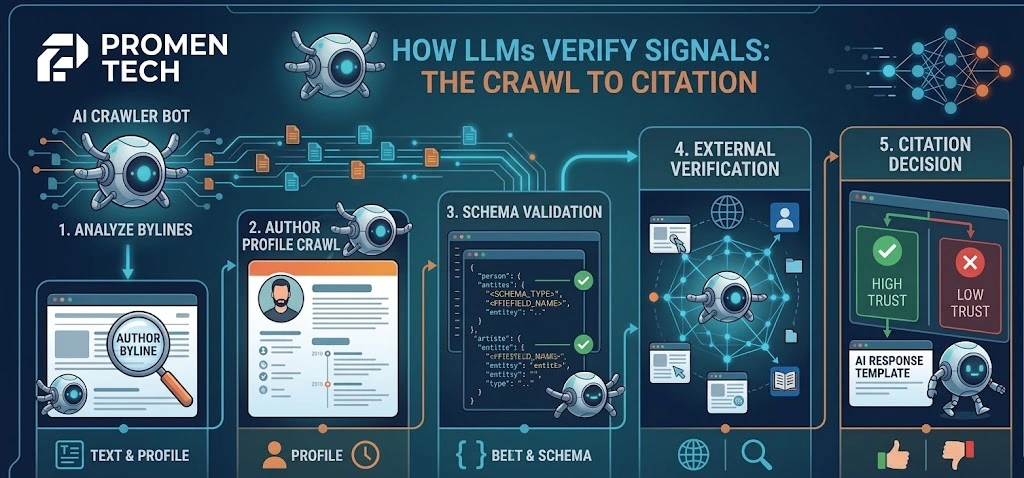
Here’s the part most teams get wrong. AI models don’t judge trust by reading tone or vibe, the way a person would. They read machine-readable signals instead:
- Bylines.
- Author bio pages.
- Person schema.
- External mentions of the author.
- A publisher’s track record.
Each one is a data point a model can check against the others, the same way a fact-checker cross-references a source before running a story. That’s why an anonymous “posted by admin” byline is worse than useless in 2026. It gives a model nothing to verify. A named author with a detailed bio and schema markup gives the model a thread to pull. It can confirm the author is real and decide whether the claim is safe to repeat.
Not sure what your own site is signaling. Our E-E-A-T Optimization work audits every signal above and fixes the gaps quietly, keeping AI models from trusting you.
The E-E-A-T Scoring Checklist
Score your site honestly against each row. Two points if it’s fully in place, one if it’s partial, zero if it’s missing.
| Signal to Check | 2 Points | 1 Point | 0 Points |
| Author bylines | Named expert on every article | Named author, thin bio | Anonymous or “staff” |
| Author schema | Person schema with sameAs links | Bio page, no schema | No author page at all |
| Sourced claims | Every stat linked to a source | Some claims sourced | Unsourced claims throughout |
| External mentions | Author cited elsewhere on the web | A few scattered mentions | No presence beyond your site |
| Freshness | Reviewed and updated within the year | Updated occasionally | Untouched for over a year |
| Platform presence | Active on 4 or more platforms | Active on 1 to 3 | Website only |
Sources: Contently 2026 E-E-A-T and AI search research, Zyppy’s 54-study AI citation meta-analysis
Add up your score out of 12. Below six, AI models likely see your site as a coin flip. Above nine, you’re in strong shape to earn consistent citations.
What Each Row Is Worth in Practice
- Sourced statistics alone lift AI visibility by 22%.
- Direct quotations add another 37%.
- Brands active on four or more platforms are 2.8x more likely to turn up in a ChatGPT answer.
- 65% of AI bot visits go to pages updated within the past year.
The Trust Gap Most Software Sites Don’t Notice
Here’s where most B2B software sites lose points without realizing it:
- Product pages and docs are usually well-written and accurate, but rarely tied to a named person.
- Case studies read like marketing copy instead of a firsthand account.
- Blog posts get published under a generic company byline.
- Each of those is a small trust leak on its own. Stacked together, they tell a model there’s no verifiable human behind the content.
The Part Most Teams Miss
A 2026 Goodfirms survey found the one unanimous result in the entire report: every marketer surveyed agreed E-E-A-T will matter more this year. The same research also found E-E-A-T is widely misunderstood. Most teams treat it as something they control on their own page, like a bio section. What actually moves the needle is what other people and other sites say about you. Consensus from elsewhere carries more weight than anything you write about yourself.
That’s a hard habit to break, because it feels backwards. Most content teams are used to controlling every word on their own page. Building real authority means stepping outside that page entirely. Get a founder quoted in an industry publication. Get a product manager’s name attached to a talk. Earn a mention on a site the team doesn’t own. None of that shows up on a normal content calendar, which is exactly why it gets skipped.
This same shift toward tracking real signals over vanity numbers is what we covered at the end of the monthly SEO report. Trust signals compound the same way rankings do. They need a live process, not a one-time fix.
Get Your E-E-A-T Score Before a Competitor Gets Cited Instead
E-E-A-T isn’t a box you check once. It’s the filter AI models run before they’ll say your name at all, and it’s being checked on every single query, every day.
Book your free growth audit, and we’ll score your site against the checklist above, then show you exactly which trust signals are costing you AI citations right now.
FAQ
1. Is E-E-A-T an official Google ranking factor?
Not directly. It’s a framework from Google’s quality rater guidelines. But the same signals now shape both search rankings and AI citations.
2. What’s the difference between Experience and Expertise?
Expertise is knowledge. Experience is firsthand contact with the topic. AI models increasingly reward the second one, since it’s harder to fake.
3. Does author schema actually make a measurable difference?
Yes. Person schema gives AI models a machine-readable way to verify who wrote something and where else they publish, which strengthens every other trust signal.
4. Can a small software brand build strong E-E-A-T without a big content team?
Yes. Start with named bylines, real author bios, and sourced claims on your highest-traffic pages first. Depth matters more than volume here.
5. How is E-E-A-T different for AI search versus regular Google search?
The core signals are the same. AI search just uses them for a sharper decision: not where to rank a page, but whether to repeat it at all.
6. What’s the fastest way to find my biggest E-E-A-T gap?
Run the scoring checklist above against your five highest-traffic pages. Whichever row scores lowest across all five is where to start.