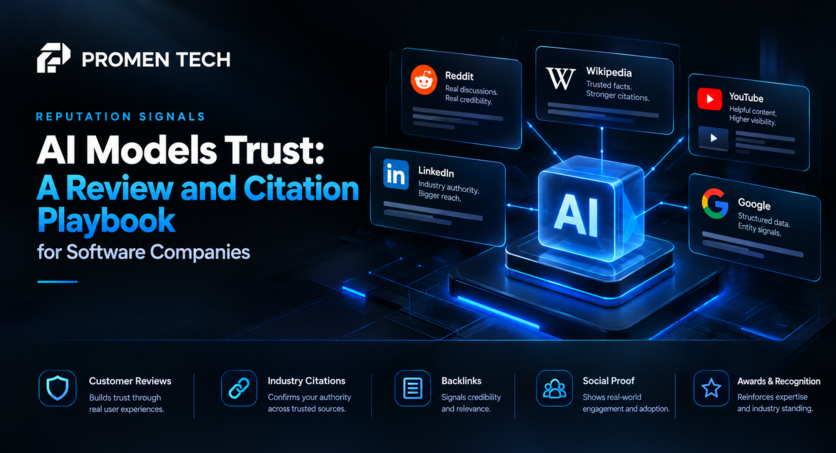

Most software companies still treat reviews as a sales enablement task. Someone on the marketing team collects a few, drops them on the website, and moves on. That's a mistake now. Review platforms have become one of the clearest signals AI models use to decide who's real, who's trustworthy, and who gets named when a buyer asks for a recommendation. This playbook breaks down which platforms actually matter, what review data really does inside an AI answer, and a practical plan for earning and tracking it.
Why One Company Now Controls Half the Review Citations AI Engines Use
Before the deal, five platforms split most of the review-based citations inside Google's AI Overviews. A study of 30,000 commercial keywords and over 211,000 cited links found these five platforms account for 88% of all review-platform citations combined.
The stakes go beyond citation share, too. Per G2's own 2025 Buyer Behavior Report, GenAI chatbots are now the single biggest influence on B2B vendor shortlists at 17.1%, narrowly ahead of review sites themselves at 15.1%. AI chat and review platforms increasingly work as a pair. One builds the shortlist. The other is where it checks its work.
Map February's acquisition onto that data, and the shift is stark. G2 now owns three of the five, together holding 53.7% of every review-platform citation across AI Overviews. TrustRadius stays independent. Gartner kept only its own Peer Insights product.
The Review Platform Priority List
Here's where to actually spend review-generation effort first, ranked by real citation share rather than by which platform sends your sales team the most emails.
| Platform | Share of Review-Platform AI Citations | Why It Matters for B2B SaaS |
| Gartner Peer Insights | 26.0% | Still independent; carries enterprise-buyer weight |
| G2 | 23.1% | The default starting point for most B2B software categories |
| Capterra | 17.8% | Now under G2, reaches a broader SME audience |
| Software Advice | 12.8% | Also under G2; worth claiming even if traffic feels lower |
| TrustRadius | 8.3% | Independent; rejects roughly 48% of submitted reviews, the hardest platform to game |
Source: MaxAEO's analysis of SE Ranking's review-platform citation study
Claim a profile on all five if your category allows it. G2 and Capterra first, since together they're nearly as influential as the other three combined.
Reviews Do Three Jobs. Only One of Them Is Ranking.
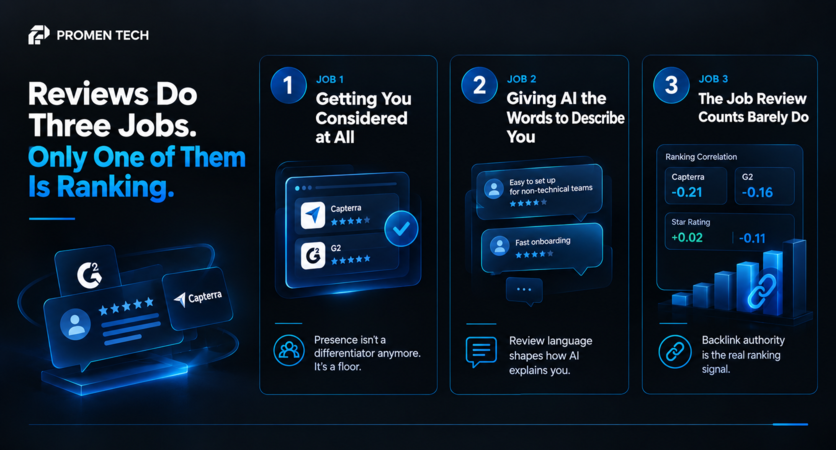
This is the part most review-strategy advice gets wrong, and it's the reason "just get more reviews" is weaker advice than it sounds. Reviews actually do three separate jobs inside an AI answer, and they don't carry equal weight.
Job 1: Getting You Considered at All
This job is close to binary. In one analysis of tools named across dozens of high-intent ChatGPT queries, 100% of recommended tools had a Capterra profile and 99% had a G2 profile. That beat even Wikipedia, which showed up on just 78.8% of the same tools.
Presence isn't a differentiator anymore. It's a floor. Skip it, and you likely never enter the candidate set an AI model builds before it even starts comparing options.
Job 2: Giving AI the Words to Describe You
A model might summarize a tool as "praised for fast onboarding, criticized for limited reporting." That phrasing usually traces straight back to aggregated review language. It rarely comes from your own marketing copy.
This is the most underused lever in the whole system. If reviewers consistently describe your product as "easy to set up for non-technical teams," that exact phrase tends to show up when AI models describe you to a buyer.
Job 3: The Job Review Counts Barely Do
Here's the uncomfortable finding. Review volume showed a weak, slightly negative correlation with ranking position in one large study, -0.21 for Capterra and -0.16 for G2. Average star rating did almost nothing either, +0.02 for Capterra and -0.11 for G2.
Tools with a few hundred reviews sometimes outranked tools with tens of thousands. The strongest ranking signal in that same study wasn't a review metric at all. It was backlink authority. Review count and star rating matter for getting you noticed. They do almost nothing for where you land once you are.
Two Tools, Same Category, Different Review Math
Picture two project management tools in the same G2 category.
Tool A has 4,200 reviews and a 4.1-star average. Most reviews are short, generic, and a year or more old. "Good product, does what it says."
Tool B has 380 reviews and a 4.4-star average. Reviews are recent and specific. "Cut our sprint planning time in half." "Best Slack integration we've tested." Each one names a concrete use case.
When a buyer asks ChatGPT to compare project management tools, Tool B's specific language is far more likely to surface in the answer, even with a tenth of the review count. Volume built Tool A's reputation with humans scanning a star rating. Specificity built Tool B's reputation with a model looking for something to quote.
See exactly where your reviews stand today. Our Online Reputation Management work audits your presence, language, and freshness across every platform on the list above, then builds the specific plan to close the gaps.
How Each AI Engine Actually Treats Reviews
Engines don't all use review data the same way, and treating them as one channel will mislead your strategy:
- Google AI Overviews cites review platforms visibly and often. Review sites earned 8.5% of all links and appeared in 34.5% of the responses analyzed.
- ChatGPT treats reviews more as a background trust check than a citation. Your profile shapes whether you're considered, but the aggregator itself rarely appears as the named, linked source.
- Perplexity behaves closer to AI Overviews. It frequently surfaces comparison and review pages directly as cited sources.
That split matters. A review platform can quietly decide your ChatGPT eligibility while never once showing up as a visible citation. That's easy to miss if you're only tracking clicks.
The Earning and Monitoring Playbook
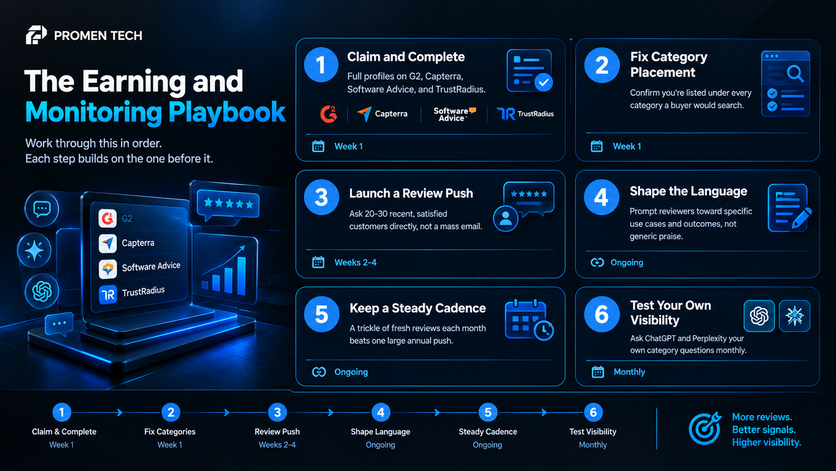
Work through this in order. Each step builds on the one before it.
| Step | Action | Timeline |
| 1. Claim and complete | Full profiles on G2, Capterra, Software Advice, and TrustRadius | Week 1 |
| 2. Fix category placement | Confirm you're listed under every category a buyer would search | Week 1 |
| 3. Launch a review push | Ask 20-30 recent, satisfied customers directly, not a mass email | Weeks 2-4 |
| 4. Shape the language | Prompt reviewers toward specific use cases and outcomes, not generic praise | Ongoing |
| 5. Keep a steady cadence | A trickle of fresh reviews each month beats one large annual push | Ongoing |
| 6. Test your own visibility | Ask ChatGPT and Perplexity your own category questions monthly | Monthly |
Step four is where most teams underperform. A review that says "great product" gives a model nothing to repeat. A review that says "cut our onboarding time from three weeks to four days" gives it an exact phrase worth quoting.
This same pattern shows up elsewhere too. Treat a signal as a floor to clear, not a lever to max out. That's exactly what we found when we mapped Google Business Profile setup for SaaS brands. Presence beat volume in both cases.
Build a Reputation AI Models Actually Trust
Review platforms are no longer a nice-to-have for software companies. They're one of the clearest signals standing between your brand and getting named the next time a buyer asks an AI model who to trust. Most SaaS teams still treat this as a task for later. The gap between later and now is exactly what a competitor closes first.
Book your free growth audit and we'll show you exactly where your review presence stands across every platform that matters, and which one to fix first.
FAQ
1. Do I need profiles on every review platform, or just G2?
Claim as many as your category supports. G2 and Capterra together account for over 40% of review-platform citations, but Gartner Peer Insights and TrustRadius still carry real weight independently.
2. Will adding hundreds of new reviews improve my AI ranking?
Not much on its own. Review volume showed a weak, slightly negative correlation with ranking position in recent research. Presence and review language matter far more than raw count.
3. Does a high star rating help get recommended by ChatGPT?
Barely. Star rating showed close to zero correlation with ranking position. A high rating supports trust, but it isn't a strong ranking lever by itself.
4. How fast do new reviews show up in AI answers?
It varies by engine. Google AI Overviews and Perplexity can reflect changes within days to weeks. ChatGPT's training-based behavior tends to lag longer.
5. Should I worry more about G2 or my own website's testimonials?
Both matter, but they're not interchangeable. Your website states your own claims. Review platforms supply the third-party validation AI models weight far more heavily.
6. What's the single highest-leverage fix for most SaaS companies?
Category placement. A profile listed under the wrong category can miss the shortlist entirely, no matter how many good reviews sit underneath it.